I drive to Portland, Maine, for the second annual
International Cryptozoology Conference. The ICC is produced by the International Cryptozoology Museum, which
was founded by one of the biggest names in the field, Loren Coleman. I’ve read
about him and his research since I was a kid- his hundreds of books, articles, and
interviews are widely published. I take my copy of Cryptozoology A to Z with me
in case I get the guts to ask him to sign it.
 |
| Monsters in America map, courtesy of the International Cryptozoology Museum |
Broadly, cryptozoology is the “study of hidden animals”, but
of course it’s more specific than that. Cryptozoologists seek to prove or
disprove the existence of certain animals for which there is anecdotal evidence
for, but as yet no scientific evidence. This includes new species as well as
declared extinct species that may have surviving remnant populations (a big win for the field was when"extinct" coelacanths were rediscovered.) The field
differentiates between hidden animals: sasquatch, dogmen, and ABCs (alien big
cats) are cryptids, whereas unicorns and dragons are not. The line that separates "cryptids" from "myths" is about as straightforward as Lombard Street. Loren Coleman’s definition
of the field is, kind of unsurprisingly, more glowing than the Wikipedia entry. Most
zoologists and other scientists feel cryptozoology is a pseudoscience, that it
doesn’t follow the scientific method and relies too heavily on anecdotal
evidence. Coleman and other cryptozoologists feel they are following in Fortean footsteps, seeking to expand our knowledge base by focusing on the anomalies.
I fall somewhere in the middle. Humans have identified 1.2 million species on this planet, and a 2011 National Geographic article predicted there are 8.7 million unknown species. That means of all the biomass on Earth, we don't know what 86% of it is. That's yuge. And cryptozoologists would say that their goal is simply to increase the number of known species. Well, I'll drink to that, for sure. I love mysteries and hidden treasures and animals, so this is definitely a field that has my attention. But do I think that the Loch Ness Monster exists? Do I think that Sasquatch roams the Pacific Northwest, and if so, that they're inter-dimensional beings? Eh, I don't know. I think Nessie is much more likely a case of misidentification, and that if Sasquatch exists then it's biological, not astral. Generally what I'm excited about are the anachronistic animals: things like thylacine sightings when they've been assumed extinct since the 1930s, and black panther and other big cat sightings in areas far from their natural ranges. Those animals are grounded in reality while still obscured by a scrim of mystery.
 |
| Dwight Schrute understands my fence-sitting |
 |
| "Benjamin", the last known thylacine, died at Hobart's Beaumaris Zoo in 1936 |
I check in to the conference, held at a local hotel, and spanning one conference room and two vendor rooms. For being a niche interest, the conference is sold out (130 attendees) and more people approach the check-in table to see if they can attend. My welcome packet includes the day's schedule, a town map, a ICM button and sticker. There are 8-10 panels, with breaks throughout the day for food, vendors, and networking. I'm impressed with the variety of lectures, and with how far some people have traveled to be here. Several audience members are from the west coast, at least one panelist is from Canada, and their areas of interest and expertise are as far-ranging as themselves.
What really surprises me is how, well, normal most of the attendees look. Which is absolutely a charged, prejudiced thing to say, but it's my reaction. I expected more of the folks to seem social unaware or stereotypically nerdy, I guess. It's a big reality check for me, that I need to be much less judgmental and presumptuous. There are only three questionable hat choices, and a scattered few people in tactical outdoor gear who make unnerving eye-contact. I move chairs throughout the day, and sit next to people who look like suburban housewives, hipster artists, men who fit the "lumbersexual" aesthetic and women who look like they came directly from a posh yoga studio. There are people of all ages: the youngest looks about 10, and the oldest must be in his eighties. There are professors and business professionals and, yes, a couple odd ducks. But the majority of the people there you'd pass in the grocery store and not know they were a big nerd for fresh water lake monsters. My first revelation of the day isn't about monsters- it's about how I need to stop being so damn judgmental and snotty.
I sit in the back and take out a notebook. I don't know if it's my anxiety disorder or disrupted sleep, but my short-term recall isn't great. Writing notes and doodling helps me focus and remember better. Immediately a dude next to me leans over and says "Oh, you must be a member of the press." I tell him I'm writing for myself, not for an article, but he finds me throughout the conference to ask me how my article is going. I can't tell if he's joking with me, or really thinks I'm infiltrating the conference. At one point, he gives me some possible article headlines. During the young cryptozoologist panel I think that I should profile the two young women for Scream Sirens Magazine, and so maybe I will write an article after all.
 |
| Panelists line up for photos before the conference starts. Loren Coleman is in the center, black suit with orange shirt |
 |
| Notes and doodles |
The first panelist of the conference, Paul LeBlond, refutes
the the disparaging main-stream view of cryptozoology. He talks about the foundation and formation of the field, how cryptozoology used to just be zoology: that early explorers went places, talked to locals about the types of animals in the area, and then observed/captured/cataloged them. LeBlond says it's a field of duality: of science and pop-culture, of "eggheads and crackpots", of experts and amateurs. He talks about the science's "strong Fortean roots", that is, its fascination with anomalies. I don't know if that helps the field's insistence that it's a real science: Charles Fort was extremely critical of scientific study. He concludes by saying the field welcomes real scientists and amateurs alike, and that the goal should be one of active communication without unrealistic expectations. I can get behind that.
The next speaker, Joseph Zarzynski, talks about his experience as a shipwreck investigator and lake monster enthusiast, and the ways in which cryptozoologists positively impact other fields. He talks about an expedition of his to Loch Ness in which they used high-tech equipment to search for Nessie. They didn't find a plesiosaur, but they did find an intact Wellington Bomber, one of only two such examples today. Gary Kozak, who has done extensive scans of Loch Ness, was one of the technicians who helped Paul Allen find the wreckage of the USS Indianapolis last month.
 |
| The "Surgeon's Photograph" is the most famous photo of the Loch Ness Monster. Today it is generally believed to be a hoax involving a toy submersible and a sculpted body |
Probably the most well-known cryptid is Sasquatch, or Bigfoot. One of our first Ouija Broads episodes was on the subject, and our talk was a teeny speck of sand in the vast sandbox of sasquatch research and lore. (Our white Sasquatch logo was designed by Ian Kelley Design and is based on the famous "frame 352" of the Patterson-Gimlin footage of an alleged bigfoot encounter in 1967.) Cultures around the world have their own legends about wild, hairy hominids: sasquatch, yeti, skunk apes, yowies, and more. And modern scientists have just as many theories about what they are: a "missing link" or relic population of neanderthals, an unknown hominid coexisting with homo sapiens, an inter-dimensional being or astral projection, a misidentification of bears, deer, or hermits, a hoax. I think of Sasquatch as a Pacific Northwest creature, a mystery that loves our mixture of rainforest and ponderosa forests, that travels the length of BC to the forests of Washington and Oregon, and maybe into California even, but is at heart a PNW'er.
But apparently ole Sarsaparilla is known across the country. Panelist Craig Woolheater is the third lecturer, and he talks about the Texas Bigfoot Research Center, about his personal sighting in Louisiana that made him a believer, and more about bigfoot's life down south. His research identifies some interesting trends, namely that Texas bigfoot sightings correspondingly happen in the areas that get the most rainfall. Also, sightings are most often reported along waterways. He personally feels that about 20% of the reported sightings he hears of are true sightings of this creature we collectively know as "Sasquatch", and that the other 80% are a mixture of accidental animal misidentifications, hoaxes, and the odd intoxicated hallucination. I like Craig- he seems ernest and approachable. Like Zarzynski, he talks about how the work of cryptozoologists has directly benefited other scientists: his research has used hair snares in local forests, and yielded a large amount of black bear hair samples. The US Forest Service has since been able to use that hair data in their own studies of local black bear populations.
 |
| Ouija Broads stickers, for sale on Etsy |
 |
| When I saw this car in the hotel parking lot, I knew I was at the right place |
 |
| I exchanged Sasquatch stickers with the super cool dudes of Squatchachusetts, which I have an even harder time spelling than Massachusetts |
One of the lectures I really look forward to is Linda Godfrey's talk on upright canines and dogmen. My favorite way to scare myself is to read about skin-walkers and wendigos, which take the form of other animals, upright canines, or human/canine hybrids. I put skin-walkers in a paranormal, not biological category. I mean, I don't even know if I believe they exist, but I clearly put enough stock in them to be royally freaked out by stories of skin-walker encounters. Certainly I have reverence for their place in Native American lore. So when it comes to Godfrey's talk, and theories on dogmen being shape-shifters or phantoms, I'm listening as someone who loves ghosts and magic and not necessary as a cryptozoologist.
Dogmen have a few main archetypes. One is the K9-Type, which is rather werewolf in appearance, with their lower legs having the hocks and "backward" knees of a canine. Another is more humanoid in musculature, like a sasquatch, but with a dog-like head instead of a gorilla-like one. Godfrey talks about her research, as well as more well-known sightings, like the Palmyra Pack (five upright canines that approached and flanked a house in Palmyra, Maine), the Beast of Bray Road (a rash of werewolf sightings in Wisconsin that started Godfrey's research), and others. She talks about the phantom black dogs of England (i.e. Black Shuck), how many North American dogmen sightings center around the Great Lakes, and whether or not she thinks they're biological or spiritual (answer: she doesn't know, but assumes a mixture of both, plus hoaxes and misidentifications.) During the break, I check out her author table. I buy a copy of her book American Monsters, and she graciously signs it, including her name and a small cartoon werewolf complete with fleas. (Godfrey is also a fantastic artist, having started as a cartoonist for a newspaper before becoming a journalist as well.)
 |
| Godfrey during her lecture |
The conference is held about a half mile from the International Cryptozoology Museum, so of course I have to check it out on my lunch break. I think about linking up with the other singles and groups that are walking the same direction, around the Amtrak station and through a parking lot, but I'm feeling shy and and a little antisocial. The museum is great, but definitely suffers from two things: unclear entry signage through a small restaurant (there's another entrance on the other side of the building, but the entrance I take is really unclear), and lack of space. I mean, don't get me wrong: it's a cool museum. But, as the introductory video you watch before entering says, there are over 10,000 artifacts, and they're in cases and displays down two what are effectively dead-end hallways. There's no way to back up to see fully what's in each case, and the lack of flow-through means you're always bumping into another guest or in their way, even when there are only a few others around you.
But I love the range of items. Most are small: photos, drawings, newspaper clippings and photos. The cases are broken down by basic animal, with the large Sasquatch/Bigfoot/Yeti collection upstairs. Of course, my favorite is the small section on thylacines (aka Tasmanian tigers/Tasmanian wolves), my favorite animal. It almost looks like a shrine, with a diorama and photos and other ephemera.
 |
| Museum sign and Sasquatch |
 |
| Little thylacine shrine |
 |
| I was probably too close to this artifact |
 |
| I don't consider the Man Eaters of Tsavo to be cryptids, but they definitely were anomalies. These maneless male lions attacked, killed, and sometimes ate possibly as many as 135 people |
The small space is packed with people. Which takes perhaps only 30 people to do, but it's still a lot considering the niche interest and $10 entry fee. I don't spend nearly as much time as I'd like- I'm too in the way, too claustrophobic feeling. I glance at most things, but am only able to give them a cursory sweep without reading labels. It's as packed upstairs, but half of it is a loft, so there's the illusion of space. There's a large section devoted to Mothman (another creature I think is more paranormal than biological but whatever), and then the largest section is devoted to Sasquatch and hominids. Replicas, footprint casts, endless newspaper clippings, artist renderings, kitschy art, plush toys, and all manner of artifacts are prettily displayed in cases and cabinets. There's a huge 8-foot-plus recreation, but I can't back up far enough to take a photo of the whole thing. I try to do a face-swap through Snapchat with him, but the app won't open and there are people waiting for my spot. Back downstairs in the gift shop, I purchase some patches and postcards. I'm surprised they don't have more small tchotchkes, a bigger selection of postcards. I feel like the novelty of those items would make them great sellers.
 |
| Small section of the Sasquatch case |
 |
| Patches/sticker/pin from the museum and postcard from the conference |
 |
| The museum's smallish giftshop was definitely made up for by the conference vendors. I had a lovely chat with several, including the sweet lady who runs who makes adorable clay Sasquatch figures and sells them from her shop Swankies, the cool illustrator behind Pickled Punks, and the rad jewelry artist of Primal Adornments |
I have some of the best French fries I've ever had from the Mainely Burgers food truck before I head back to catch the Young Cryptozoologists panel. Wen of Cryptid Wendigo, Chloe, a filmmaker, Andy of the Saswhat podcast, and cryptid/bug enthusiast, Thomas, make up the panel, ranging from pre-teen to college-aged. They are sweetly awkward in the way that only teenagers can be: sometimes painfully aware of the intense attention they're receiving, and at other times so ernest it makes your heart ache. They have really diverse cryptid interests, and speak with a lot of humor and intelligence about their passions. The thing that resonates most with me is said by Andy, the son in the father/son duo behind Saswhat. A guest asks the panel their thoughts on the UFO/Bigfoot connection, of the overlapping reports of sightings and how some people claim that Sasquatch are actually aliens. Andy answers with, "You shouldn't answer a mystery with a mystery." I like that. To say that Bigfoot, an unknown, is an alien, another unknown, doesn't get us closer to an answer, isn't disprovable, or add to the knowledge base. It is, to my mind, a form of question dodging. Don't answer a mystery with a mystery. I'll come back to that thought over and over again in the coming weeks.
It's break time, and I grab my book and my courage and try to find Loren Coleman to see if he'll sign it. I can't seem to catch his eye in the lecture hall, and I know he's really busy so I don't want to intrude or corner him. He's been completely involved with the entire conference- making sure we keep to the schedule, helping to introduce panelists, networking and greeting and ensuring folks are happy. I follow him out into the hall, and just as I'm going to ask him for his signature, he hands me a camera and asks me to take a photo of him and one of the young cryptozoologists. Then another photo of him and a different young cryptozoologist. I know I'm going to sneak away before the very end of the conference so I get bold and ask him if he'd sign my book before he has a chance to take more photos or talk to someone else. Kindly, he does, and then says he has to get back in for the next panel because he knows it's likely to ruffle some feathers.
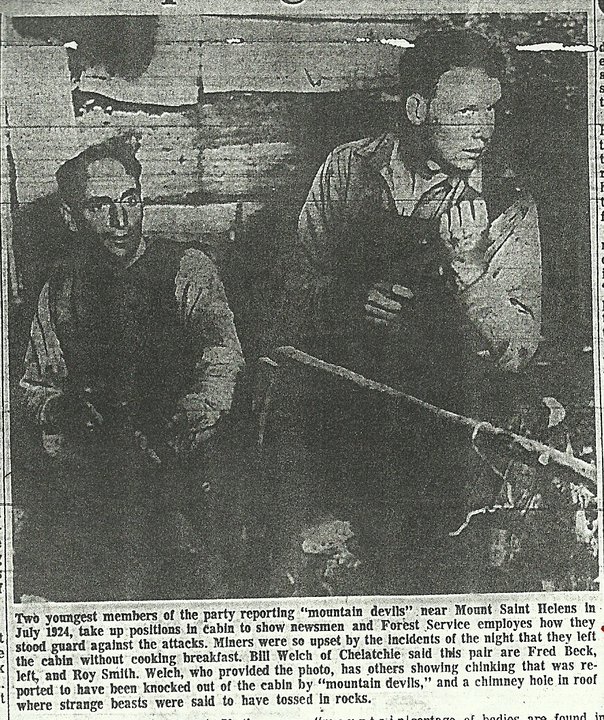
Boy, is he right. Robert Schneck is talking about the Ape Canyon Incident, when a group of miners claimed they were harassed by a group of sasquatch which lead to a miner shooting one, culminating in an attack of the miner's shack by the apemen. Later in life, one of the miners claimed that the apemen were mystical beings from another dimension, and that he had lifelong dreams and premonitions about him. Schneck's lecture is about his own research into the incident and that Sasquatch may be an inter dimensional being from a different plane of existence. He talks about how the miners were reportedly spiritualists, and that the Ape Canyon Incident is perhaps a modern example of the "magical treasure hunt" trope. You can feel the energy in the room shift. Or maybe Coleman primed me to think the energy would be different. But it really does seem to me that people are more agitated, that the general consensus is that Sasquatch are biological, not spiritual. To be fair, at this point in the day I'm exhausted and my mind is wandering, so I don't think I get the full impact of the lecture. My notes are increasingly becoming doodles, and then just lines.
 |
| An article about the ACI, with the miners recreating the siege at the cabin |
I'm a little more awake for Bruce Champagne's lecture: an Introduction to Sea Serpent Types. He talks about the main types, using phrases like "long-necked," "many-humped," "super otter," and "Father of All The Turtles" to differentiate them. Many marine cryptids look like relic cetaceans/reptiles, or gigantic versions of known species. Champagne has gathered thousands of datapoints to create a rubric to inform his categories. I like how much thought he's put into differentiating the types. He's commissioned an artist to illustrate the archetypes as well.
 |
| Sea serpent types displayed during Champagne's lecture |
 |
The largest known turtle is the leatherback turtle, which is known to grow up to 9 feet long. However, gigantic turtles have been reported by explorers forever, with Christopher Columbus describing a whale-sized turtle, and the crew of the Annie L. Hall reporting a 40' long turtle that swam alongside their ship in 1883.
[source] |
There's a final lecture before the silent auction winners are announced, two researchers talking about Vermont monsters. But I'm exhausted and have a two-hour drive back home, so I slip out quietly. On the drive home I keep my eyes peeled for strange creatures on the side of the road, but the heavy rain obscures everything but the cars in front of me.
***
In a 2002 NPR interview, Dr. Jane Goodall was asked if she believed in Sasquatch. She talked about tribal lore, about sightings and researchers. And she concluded by saying she was a romantic, that there was an allure to believing in something even if there's no evidence for it. She says: "Of course, the big, the big criticism of all this is, "Where is the body?" You know, why isn't there a body? I can't answer that, and maybe they don't exist, but I want them to."




#/media/File:Sanfran_61_bg_032605.jpg)
